
This page will help you understand questions such as:
- What level of evidence does an NHS commissioner expect before adopting an innovation?
- Is there a minimum level of evidence required for NHS adoption?
- How does the evidence required differ between a pilot and large-scale implementation?
- Does the setting in which an innovation is used affect the evidence needed?
- How can innovators build evidence in a way that supports long-term NHS adoption and commissioning?
Bringing an innovation into the NHS often raises the same question: how much evidence is enough? The answer can be frustratingly unclear because there is no single evidence threshold that applies to every innovation, every organisation, or every stage of adoption.
NHS commissioners, providers, and decision-makers are ultimately looking for confidence that an innovation is safe, effective, acceptable, deliverable, and represents good value for money. The level of evidence required depends on factors such as the maturity of the innovation, the risks associated with its use, the size of the proposed implementation, and the setting in which it will be deployed.
Is there a minimum level of evidence required?
There is no universal minimum evidence requirement across the NHS. Different organisations may have different thresholds depending on their priorities, risk appetite, and commissioning responsibilities. Despite this, most NHS decision-makers will expect innovators to demonstrate:
- A clearly defined problem that the innovation addresses
- Evidence that the innovation is safe to use
- Evidence that the innovation can deliver the intended outcomes
- Evidence that the innovation can be implemented successfully in practice
- An understanding of costs, benefits, and potential return on investment
Increasingly, NHS organisations are looking beyond technical performance alone. An innovation may perform well in laboratory testing or controlled environments, but commissioners are often more interested in whether it works in real-world healthcare settings.
For digital health technologies, frameworks such as the NICE Evidence Standards Framework provide guidance on the type and strength of evidence expected depending on the function and potential risk of the technology. NICE states that the level of evidence required should be proportionate to the risk and intended purpose of the innovation.
How does evidence differ between a pilot and scale-up?
The evidence required for a pilot is different from the evidence required for wider adoption.
Early-stage pilots
At the pilot stage, NHS organisations are typically trying to answer a relatively simple question: Could this innovation work in our setting? Evidence at this stage may include:
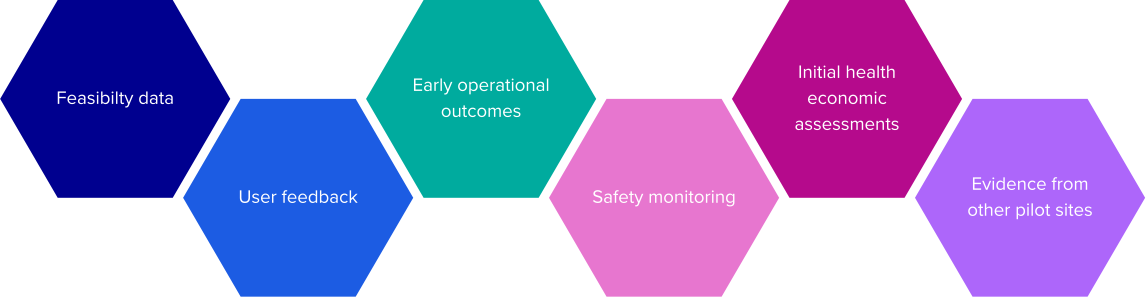
The purpose is often to reduce uncertainty and determine whether further evaluation is justified. Decision-makers generally understand that early-stage innovations will have a developing evidence base. They are often willing to accept lower levels of evidence if the proposed pilot is well designed and the potential benefits are compelling.
Adoption and scale-up
As an innovation moves towards wider adoption, the question changes: Can this innovation consistently deliver benefits across multiple organisations and populations? At this stage, decision-makers usually want stronger evidence relating to:
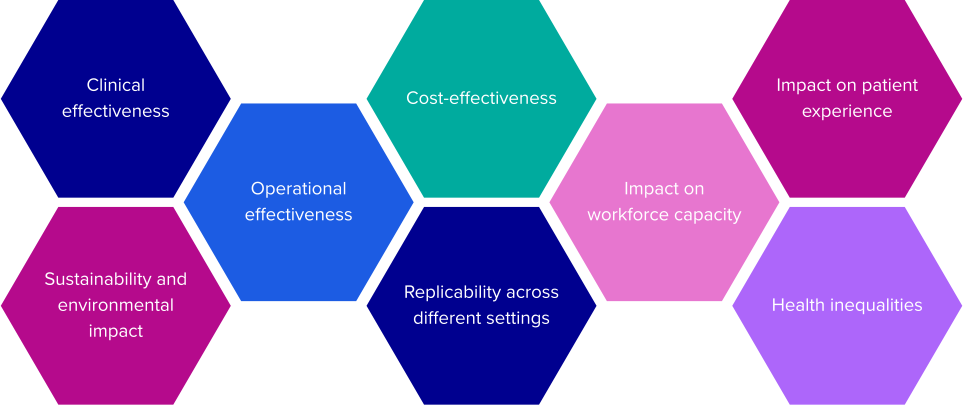
Evidence generated from a single enthusiastic site may not be sufficient. Commissioners often seek reassurance that benefits can be achieved consistently across different teams, patient groups, and organisations. This is where robust evaluation becomes particularly important.
Does the healthcare setting affect the evidence required?
Yes. The setting in which an innovation is used can significantly influence the level and type of evidence that NHS decision-makers expect.

Higher-risk settings
Innovations used in areas such as acute medicine, emergency medicine, diagnostics, clinical decision support, and treatment pathways often attract greater
scrutiny because patient safety risks may be higher. In these situations, stronger evidence of effectiveness, reliability, and safety may be expected before
widespread adoption occurs.

Lower-risk settings
Innovations focused on administrative processes, service improvement, staff productivity, communication, and workflow management may be
able to progress with less extensive clinical evidence, although organisations will still want to understand operational and financial benefits.
Population considerations
Commissioners may also consider:
- Which patient groups are affected
- Whether vulnerable populations are involved
- Potential impacts on health inequalities
- Whether evidence has been generated in populations similar to those who will use the innovation
Evidence generated in settings that closely resemble the intended implementation environment is often viewed more favourably than evidence generated elsewhere.
Why real-world evidence matters
One of the most common challenges innovators face is relying heavily on theoretical benefits, technical performance metrics, or evidence generated outside routine healthcare settings. NHS organisations increasingly want to see evidence of real-world impact. This includes understanding:
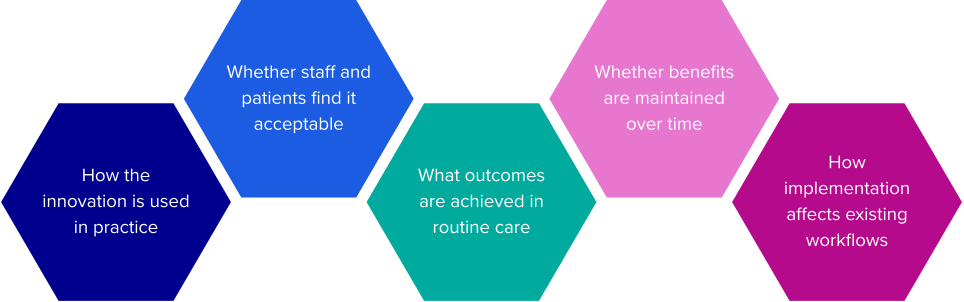
Real-world evaluation helps bridge the gap between promising innovation and confident adoption.
What types of evidence are most valuable?
A strong evidence base usually combines multiple forms of evidence rather than relying on a single study. Depending on the innovation and stage of adoption, this may include:
- Quantitative analysis: Measures outcomes using numerical data, such as waiting times, hospital admissions, diagnostic accuracy, productivity, or patient outcomes.
- Qualitative analysis: Explores the experiences, perceptions, and acceptability of an innovation among patients, staff, and stakeholders.
- Health economic analysis: Examines whether the innovation offers value for money and supports sustainable decision-making.
- Examples include:
- Cost-benefit analysis (CBA)
- Cost-effectiveness analysis (CEA)
- Cost-utility analysis (CUA)
- Cost-consequence analysis (CCA)
- Budget impact modelling (BIM)
- Examples include:
- Health inequalities analysis: Assesses whether an innovation improves, worsens, or has no effect on inequalities in access, experience, or outcomes.
- Environmental analysis: Examines environmental impacts and alignment with NHS sustainability ambitions.
- System dynamics modelling: Helps explore complex system-wide impacts that may not be visible through traditional evaluation approaches.
Building evidence strategically
Many innovators make the mistake of collecting data without a clear evidence strategy. Instead, evidence generation should be planned from the outset and aligned to the questions NHS decision-makers will eventually ask. A structured evaluation approach typically includes:

A well-designed evidence strategy can save time, reduce costs, and increase the likelihood of successful adoption.
There is no single level of evidence that guarantees NHS adoption. The evidence required depends on the maturity of the innovation, the risks involved, the implementation setting, and whether the innovation is being piloted or scaled. At a minimum, NHS commissioners and decision-makers need confidence that an innovation is safe, effective, practical to implement, and capable of delivering meaningful value. The most successful innovators build evidence progressively, using real-world evaluation and ongoing monitoring to demonstrate impact over time and reduce uncertainty as adoption grows.