
Context
Barrett’s oesophagus is a condition characterised by damage to the inner lining of the lower end of the oesophagus due to acid reflux associated with gastro-oesophageal reflux disease (GORD). This condition carries a risk of progression to oesophageal cancer over time. The capsule sponge test is a minimally invasive, non-endoscopic diagnostic method used to detect Barrett’s oesophagus and early oesophageal cancer in individuals with chronic reflux.
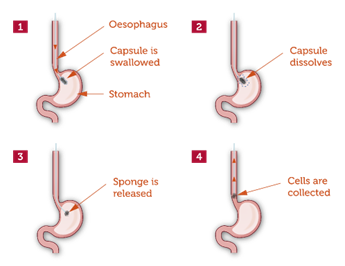
How we worked with Somerset, Wiltshire, Avon, and Gloucestershire (SWAG) Cancer Alliance
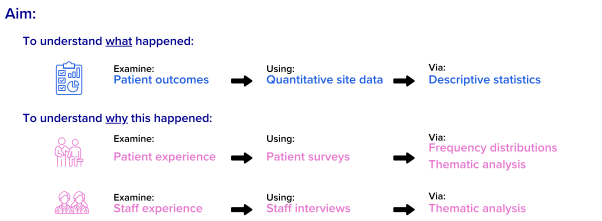
Unity Insights and Health Innovation West of England were commissioned by Somerset, Wiltshire, Avon, and Gloucestershire (SWAG) Cancer Alliance to conduct an evaluation to assess the implementation of the capsule sponge test within Minchinhampton Surgery and Somer Valley Medical Group between November 2024 and October 2025.
Findings
Patient outcomes and experience
- 70% of patients (n = 403) who were able to accept/decline the test invitation accepted the invite
- Most patients received enough information to decide whether to have the capsule sponge test, however some patients did not understand why they were offered the test
- 52% of patients (n = 301) patients who were able to accept/decline the test successfully completed a capsule sponge test, where 70 patients required an endoscopy following the capsule sponge test due to abnormal cells identified or two inadequate test results
- 51 patients completed an endoscopy at the time of data extraction, where 14 patients (27%) had a normal endoscopy test result (no conditions or findings identified), 18 patients (35%) were diagnosed with Barrett’s oesophagus, and 29 patients (57%) had a different finding or condition identified, such as a H. Pylori infection or a hiatus hernia
- Patients found the capsule sponge test pathway acceptable, however some noted concerns around expected discomfort before having the test
Staff experience
- While the initial training covered the technical aspects and navigation of relevant systems, staff from Minchinhampton Surgery indicated that greater exposure to in-person practical demonstrations would have further boosted their confidence and competence
- A well-established culture of innovation within implementing GP practices facilitated development and roll-out of the pathway
- There was ongoing debate among staff regarding whether the capsule sponge test should be used broadly for proactive case finding or more selectively for surveillance, such as in patients with Barrett’s oesophagus or those presenting with symptoms
Recommendations
The recommendations as a result of the evaluation were as follows:

To encourage uptake and reduce concerns, review the information leaflet that describes the test to increase patient understanding and perceived control.

To develop staff confidence and competence, incorporate more in-person staff demonstrations, rather than using a video demonstration.

To facilitate learning across sites, foster a culture of innovation across implementation sites through creation of a group on the FutureNHS platform that shares best
practice advice to new and current implementation sites.

To ensure safe and effective integration, optimised resource allocation, and maintained high standards of care, implement ongoing monitoring of patient outcomes.

To ensure the capsule sponge test is used optimally, consider the most appropriate patient group the test should be offered to out of proactive case finding or risk
stratification in symptomatic patients with GORD, or within surveillance pathways for those with an established diagnosis of Barrett’s oesophagus.
What value did the evaluation add?
Overall, implementation of the capsule sponge test was seen as acceptable by patients and staff. Most patients had a positive experience and received enough information to decide whether to have the capsule sponge test. Staff recognised the importance of screening, valuing the simplicity of the test compared to an endoscopy. The recommendations provided would continue to promote safe and effective implementation of the pathway.
View the evaluation report here.
“This pilot has demonstrated the real potential of innovative diagnostics to support earlier detection of some of the rarer cancers. By offering the capsule sponge test in primary care settings, we can identify conditions like Barrett’s Oesophagus much sooner and intervene, potentially before cancer develops, while also bringing care closer to home for our patients. Early diagnosis is vital in improving cancer outcomes and this is such an important step towards improving outcomes across our region.”
Ruth Carr, SWAG Cancer Alliance
“The success of this pilot shows the potential for EndoSign® to bring diagnostic services into communities, and provide a simple, effective triage tool without patients needing to make hospital appointments.”
Marcel Gehrung, Cyted Health
“This evaluation contributes to the growing evidence base supporting earlier diagnosis and proactive case-finding, central to the NHS National Cancer Plan’s ambition to diagnose more cancers at an earlier stage. It shows that delivering the capsule sponge test in primary care is feasible and generally well received by patients and staff.”
Mairead Murphy, Health Innovation West of England
“We thoroughly enjoyed taking part in the capsule sponge pilot project and would like to thank all those who made it possible. Our staff and patients greatly welcomed the opportunity to be involved in a diagnostic pathway not normally found in primary care but which, we overwhelmingly felt, could work extremely well in the future were it to be rolled out more widely.“
Dr John Beard, Minchinhampton Surgery
Other insights
Luscii-MTW SBRI Healthcare Evaluation: Scaling acute virtual wards
Unity Insights delivered an SBRI Healthcare-funded evaluation into the delivery of a Luscii-enabled acute virtual ward.
Evaluating the impact and economics of HealthTech-1
Unity Insights were commissioned to evaluate the impact of HealthTech-1 in practices across Surrey.
Evaluating the carbon and economic impact of reusable airway devices in the NHS
Evidence on carbon savings and economic value of reusable airway devices across NHS sites, systems and national scale.
An evaluation of how the capsule sponge test was implemented at Minchinhampton Surgery and Somer Valley Medical Group
An evaluation of how the capsule sponge test was implemented at Minchinhampton Surgery and Somer Valley Medical Group.
Evaluation of a theatre production to combat adolescent drug use
A mixed-methods evaluation of an initiative to combat adolscent drug use
Understanding the impact of Magic Notes through validating evaluation findings
The impact of Magic Notes at Kent County Council through validating an evaluation.
Evidencing economic benefits to reducing polypharmacy
A quantitative evaluation of the Health Innovation Network’s polypharmacy programme
Unity Insights’ Partnership with the Health Innovation Network
An overview of Unity Insights’ longstanding partnership and collaboration with the Health Innovation Network
Dorset Mental Health Forum: Measurement and Evaluation Planning
Unity Insights were engaged by DMHF to support the development of their measurement and evaluation framework.
Evaluation design and support for Surrey Mental Health and Wellbeing initiatives
Developing evaluation strategies for a wide range of mental health and wellbeing projects in Surrey
A cost-benefit analysis and high-level carbon impact analysis of the UniWee
Unity Insights conducted a cost-benefit analysis and high-level carbon impact analysis of the UniWee.
Understanding the impact of a non-endoscopic diagnostic test pathway upon cancer pathways using System Dynamics Modelling
The use of system dynamics modelling within a mixed-methods evaluation of a non-endoscopic diagnostic test pathway for B