
How we worked with Health Innovation Kent Surrey Sussex
Health Innovation Kent Surrey Sussex (Health Innovation KSS) commissioned Unity Insights to independently evaluate the WorkWell Sussex pilot programme, helping NHS Sussex understand what worked, who the programme reached, and whether it delivered value for citizens and the wider system.
Using a mixed-methods approach, quantitative analysis, participant outcome measures, staff interviews, case studies, and health economic modelling were combined to assess implementation, impact, and future sustainability. The evaluation provided strategic recommendations to support the future development of work and health services across Sussex.
Key findings
How was WorkWell implemented and delivered across local areas? What factors influenced the delivery, engagement, and effectiveness of the programme?
Delivery models varied across localities, but all used locally tailored approaches to meet population needs and improve engagement.

Strong partnerships, trusted referral routes, flexible person-centred support, and ongoing adaptation were key enablers of implementation and engagement. Short delivery timescales, limited awareness, capacity pressures, and operational challenges constrained implementation and the ability to demonstrate longer-term impact.
How does access to WorkWell vary by service user demographics?
WorkWell Sussex reached citizens from a range of backgrounds, including a substantial proportion living in more deprived communities.
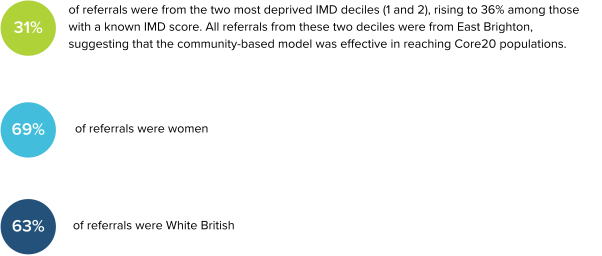
The prominence of White British citizens suggests that some minority ethnic communities may not have been reached in proportion to local need, particularly in diverse areas such as Crawley. Referral methods also appeared to shape the demographic profile of each site. East Brighton’s offer reached more younger citizens, women and people from deprived areas, while Hastings’ repeat fit note approach engaged an older population with more established health-related work absence. Women also appeared more likely than men to remain engaged through to follow-up.
To what extent does WorkWell change health and employment outcomes?
Qualitative findings identified examples of citizens moving into work, completing training, volunteering, accessing job trials and becoming more ready to engage with employment. The three delivery models supported different stages of progression. Crawley’s structured coaching model supported active jobseekers, East Brighton combined confidence-building with direct employer links that led to job trials and paid roles, and Hastings focused on job retention and return to work through occupational therapy and support with reasonable adjustments. Patient-reported outcome measures also provided early evidence of improved self-efficacy and wellbeing, supporting a return to employment.
How might WorkWell impact patient-reported experiences?
WorkWell was associated with improved work-related confidence and several aspects of mental wellbeing. Average confidence in managing health and staying in work when difficulties arose increased from 4.54 to 5.83 out of ten, a statistically significant improvement; however, respondents from the Crawley site scored, on average, below 5, suggesting that there was still a lack of confidence in managing their health and staying in work. Managing your own health and wellbeing also saw a modest increase from 2.57 to 2.83 out of 5.
Short-Warwick-Edinburgh Mental Wellbeing Score (SWEMWBS) results also saw average total scores increase from 17.56 to 22.48 out of 35, with statistically significant increases across 6 of the 7 domains.
These changes are consistent with WorkWell’s personalised approach, which combined practical goal setting, service navigation, employment support and help with wider barriers such as benefits, finances, childcare and digital access. Trusted community relationships, longer private appointments, occupational therapy and access to practical opportunities may all have contributed to improved confidence and self-efficacy.
What is the economic value of WorkWell?
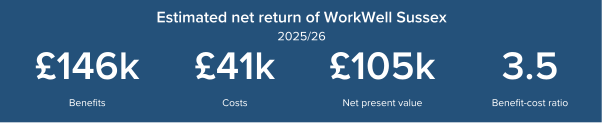
The economic modelling estimated first-year benefits of £146k, producing a net present value of £105k and a benefit-cost ratio of 3.54. This suggests that every £1 invested could generate approximately £3.54 in wider social value. Sensitivity analysis produced a mean benefit-cost ratio of £3.65, with an estimated range of £2.95 to £4.43 per £1 invested. Most of the estimated benefit, £130k, came from increased economic output associated with citizens entering or remaining in work, whilst the remainder related to estimated health-related quality-of-life gains. These findings should be treated as modelled potential value rather than realised financial savings. Employment outcomes were estimated using evidence from a comparable programme and assume sustained employment for one year.
What value did the WorkWell Sussex evaluation add?
The evaluation provided Health Innovation Kent Surrey Sussex and NHS Sussex with an independent evidence base to support future commissioning and investment decisions. Beyond measuring outcomes, it identified practical lessons about successful implementation, including the importance of trusted local partnerships, multidisciplinary support, employer engagement, and neighbourhood-based delivery models.
Most importantly, the evaluation demonstrated that WorkWell Sussex was a promising proof of concept, showing how locally tailored health and employment support can improve wellbeing, support people closer to work, and generate wider social and economic value. The findings are now helping shape the future of WorkWell services.
Read the full evaluation report here.
Our insights
WorkWell Sussex: Building the evidence base for integrated health and employment support
An evaluation of WorkWell Sussex through examining factors such as health inequalities.
How to set an evaluation up to succeed: Supporting RateMyShift in NHS Wales
See how an evaluation scoping plan helped a pilot in Swansea Bay University Health Board prepare for credible, proportio
Luscii-MTW SBRI Healthcare Evaluation: Scaling acute virtual wards
Unity Insights delivered an SBRI Healthcare-funded evaluation into the delivery of a Luscii-enabled acute virtual ward.
Evaluating the impact and economics of HealthTech-1
Unity Insights were commissioned to evaluate the impact of HealthTech-1 in practices across Surrey.
Evaluating the carbon and economic impact of reusable airway devices in the NHS
Evidence on carbon savings and economic value of reusable airway devices across NHS sites, systems and national scale.
An evaluation of how the capsule sponge test was implemented at Minchinhampton Surgery and Somer Valley Medical Group
An evaluation of how the capsule sponge test was implemented at Minchinhampton Surgery and Somer Valley Medical Group.
Evaluation of a theatre production to combat adolescent drug use
A mixed-methods evaluation of an initiative to combat adolscent drug use
Understanding the impact of Magic Notes through validating evaluation findings
The impact of Magic Notes at Kent County Council through validating an evaluation.
Evidencing economic benefits to reducing polypharmacy
A quantitative evaluation of the Health Innovation Network’s polypharmacy programme
Unity Insights’ Partnership with the Health Innovation Network
An overview of Unity Insights’ longstanding partnership and collaboration with the Health Innovation Network
Dorset Mental Health Forum: Measurement and Evaluation Planning
Unity Insights were engaged by DMHF to support the development of their measurement and evaluation framework.
Evaluation design and support for Surrey Mental Health and Wellbeing initiatives
Developing evaluation strategies for a wide range of mental health and wellbeing projects in Surrey