
How we worked with Luscii and Maidstone and Tunbridge Wells NHS Trust
Funded by Small Business Research Initiative (SBRI) Healthcare’s Phase 3 funding programme, the Scaling Acute Virtual Wards evaluation measured the impact of Maidstone and Tunbridge Wells NHS Trust’s (MTW) mature, multi-pathway acute virtual ward service model.
The acute virtual ward (AVW) aims to reduce demand on hospital beds, improve patient flow, and enhance patient experience while maintaining high clinical standards, and is being delivered using Luscii, a virtual monitoring platform enabling healthcare providers to deliver hospital-level care to patients in their homes. The AVW was first launched by MTW in 2022 for respiratory patients before being expanded to support patients from a more diverse range of clinical wards, including general admissions.
Taking place over the course of a year, this mixed-methods evaluation observed the potential outcomes in terms of economic and environmental impact, as well as staff and patient experiences and an inequalities analysis. The evaluation sits within a wider delivery programme, undertaken in partnership between MTW, Luscii, Health Innovation Kent Surrey Sussex (Health Innovation KSS), and Unity Insights.
MTW have led on a process of patient and public involvement and engagement (PPIE) to incorporate the views and perspectives of those engaging with their services, and alongside the evaluation findings, an implementation toolkit has been developed by Health Innovation KSS to capture the lessons learned and provide practical advice for interested trusts and service commissioners.
What impacts did the evaluation observe?
The evaluation scope covered four well-established clinical pathways utilising the acute virtual ward: Respiratory, Haematology, Frailty, and Acute General Medicine.
Data was provided by both Luscii and MTW to support analyses in terms of patient outcomes, health inequalities, economic, and environmental impact. Episodes for 1,090 virtual ward patients were analysed covering 12 months between July 2024 and July 2025.
Clinical impact

AVW patients experienced a reduction in hospital stay relative to matched non AVW individuals, easing pressure on acute bed capacity. While patients on the
AVW had longer end-to-end stays, the comparatively lower cost of virtual care enabled longer periods of observation prior to discharge.

Hospital returns and readmissions were lower than in the non AVW cohort. Despite this, some patients did appropriately return to hospital when assessments
identified clinical risks or the need for further treatment.

Patients from more deprived areas and older age groups had experiences and clinical outcomes broadly aligned with the wider cohort, with increased benefits
in terms of in-hospital bed days saved in some cases.

Mean reduction in hospital bed days

Reduction in expected returns and readmissions per patient
Patient experience
High satisfaction and reassurance: Patients consistently reported feeling safe, well supported, and reassured by daily monitoring and rapid responses to deterioration.
Preference for home-based recovery: Many valued remaining with family, maintaining independence, and avoiding the stress of hospital environments.
Some communication gaps: A minority reported unclear discharge explanations, anxiety during onboarding, or challenges understanding clinical information.
Surveys were undertaken to capture patient views and experiences before and after their enrolment to the virtual ward. A further survey was undertaken to capture staff views and a focus group interview with members of the PPIE group was used to develop themes and outcomes.

of post-admission patients agreed that receiving care at home was positive for their wellbeing.

of patients rated the comfort and convenience of receiving care at home as significant benefits.

Net Promoter Score based on the question “How likely are you to recommend the virtual ward to others?”
Patient views:
“I found the virtual ward a totally positive experience. Being monitored from home helped my mental wellbeing and every member of staff I came into contact with were caring and supportive.”
“I think potentially patients get to a point where they really don’t want to be there anymore and you get to a point where you might want to self-discharge… I think to be able to be given that opportunity [to move to a virtual ward], some people obviously will choose not to, but for people who are able to, I think it’s a game changer for patients.”
“The coffee is definitely a lot better at home.”
Economic outcomes
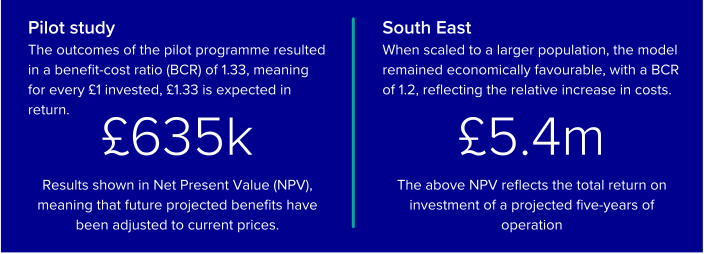
Across all scenarios, the AVW produced cost savings driven largely by avoided bed days, demonstrating a consistently positive return on investment.
Conclusion
Unity Insights delivered this mixed methods evaluation of the Luscii-enabled AVW within MTW. The findings demonstrate the AVW had clear value as a scalable, clinically safe, and patient‑centred model of acute care. By reducing pressure on hospital beds, increasing patient flow, enhancing patient experience, delivering economic and environmental benefits, and maintaining strong safety outcomes, it provides an important component of MTW’s strategy for sustainable acute care delivery whilst supporting the ‘left shift’ even within an acute trust. These findings provide an insight into the potential impact of a mature, established multi-pathway virtual ward, developing understanding for commissioners and care providers across the country as they continue to develop their own virtual care offerings.
For more information about the programme, and the evaluation’s findings, please click here.
“This independent, rigorous evaluation gives us compelling evidence of the wider impact of MTW’s mature acute virtual ward – from patient outcomes and inequalities to economic and environmental benefits, which are often aspects that are not a part of standard reporting. Seeing that impact modelled at scale, alongside a practical blueprint others can learn from, is incredibly valuable as we look to expand virtual care, both within Kent and Medway and nationally.”
Cecilia Price, Luscii Impact Specialist
Our insights
How to set an evaluation up to succeed: Supporting RateMyShift in NHS Wales
See how an evaluation scoping plan helped a pilot in Swansea Bay University Health Board prepare for credible, proportio
Luscii-MTW SBRI Healthcare Evaluation: Scaling acute virtual wards
Unity Insights delivered an SBRI Healthcare-funded evaluation into the delivery of a Luscii-enabled acute virtual ward.
Evaluating the impact and economics of HealthTech-1
Unity Insights were commissioned to evaluate the impact of HealthTech-1 in practices across Surrey.
Evaluating the carbon and economic impact of reusable airway devices in the NHS
Evidence on carbon savings and economic value of reusable airway devices across NHS sites, systems and national scale.
An evaluation of how the capsule sponge test was implemented at Minchinhampton Surgery and Somer Valley Medical Group
An evaluation of how the capsule sponge test was implemented at Minchinhampton Surgery and Somer Valley Medical Group.
Evaluation of a theatre production to combat adolescent drug use
A mixed-methods evaluation of an initiative to combat adolscent drug use
Understanding the impact of Magic Notes through validating evaluation findings
The impact of Magic Notes at Kent County Council through validating an evaluation.
Evidencing economic benefits to reducing polypharmacy
A quantitative evaluation of the Health Innovation Network’s polypharmacy programme
Unity Insights’ Partnership with the Health Innovation Network
An overview of Unity Insights’ longstanding partnership and collaboration with the Health Innovation Network
Dorset Mental Health Forum: Measurement and Evaluation Planning
Unity Insights were engaged by DMHF to support the development of their measurement and evaluation framework.
Evaluation design and support for Surrey Mental Health and Wellbeing initiatives
Developing evaluation strategies for a wide range of mental health and wellbeing projects in Surrey
A cost-benefit analysis and high-level carbon impact analysis of the UniWee
Unity Insights conducted a cost-benefit analysis and high-level carbon impact analysis of the UniWee.